by Irtija AHMAD
On September 1st, Pakistan Prime Minister Shehbaz Sharif assumed the chairmanship of the Shanghai Cooperation Organization (SCO) at Bishkek for the 2026-2027 term, under a theme his government chose turning Vision into Action Connectivity, Innovation and Shared Prosperity. Using the platform, he made the argument Islamabad has been making for years, pakistan ports give landlocked republics of Central Asia their shortest route to the sea.
For a country routinely described as regionally isolated, chairing a working regional organization is not what isolation looks like and the route there explains a good deal about the past decade of Pakistani foreign policy.
A framework that still meets
South Asian regionalism has not been functional for quite some tin. SAARC has not held a summit since Nepal hosted in 2014, and the 2016 meeting that pakistan was due to host collapsed before even beginning. Former Pakistani foreign secretary, Aizaz Ahmed Chaudhary, described the organization last December as having produced no significant activity in the decade since, owing to bilateral disputes that cannot be resolved by its members.
The response of Pakistan was not abandoning regionalism. Instead, it changed which region it worked in. over the past decade, Islamabad has put its multilateral weight behind the SCO and the Economic Cooperation organization. Both meet, both have central Asian membership and neither is hostage to the dispute that froze SAARC. The chairmanship is the visible result of a recalibration that has been in process for years.
Read that way, the Central Asian outreach is not a consolation prize for a neighborhood that stopped cooperating, it is where Pakistan’s regional strategy now lives.
What February actually produced
The diplomacy has been concrete. In the first week of February, Islamabad hosted two heads of states in as many days.
President Kassym-Jomart Tokayev of Kazakhstan arrived February 5 and left with a strategic partnership declaration, an extradition treaty, a transit trade agreement and 37 memoranda of understanding covering, mining, railways, petroleum, agriculture and defence. Pakistan offered Kazakhstan full access to its seaports and transit infrastructure. The two governments set a trade target of $1 billion, against a base of roughly $250 million.
President Shavkat Mirziyoyev came the same week. The joint declaration reaffirmed a $2 billion target by 2029, committed Pakistan to seaport access for Uzbek transit cargo, and pushed for progress on the Uzbekistan-Afghanistan railway, whose framework the three countries signed in Kabul in July 2025.
Extradition treaties and transit agreements should not be reduced to mere photo opportunities. They are the legal plumbing that freight needs before it can move at scale, and Pakistan spent the past year installing it.
The Hormuz proof
Then the argument got tested, by nobody’s design.
The Strait of Hormuz closed to commercial traffic at the end of February after Us-Israel led strikes on Iran. War risk cover was withdrawn, vessels were stranded inside the Gulf, and the corridor running through Bandar Abbas degraded within weeks. Six months on and it has still not recovered. Transits have crept upward, but the U.S. Naval Institute reported in late August that traffic remains a fraction of pre-war levels, that ships are still being fired on, and that the industry is working under crisis conditions rather than anything close to normal. Rather than sailing through, tankers now hand their cargo to other ships beyond the strait and turn back,
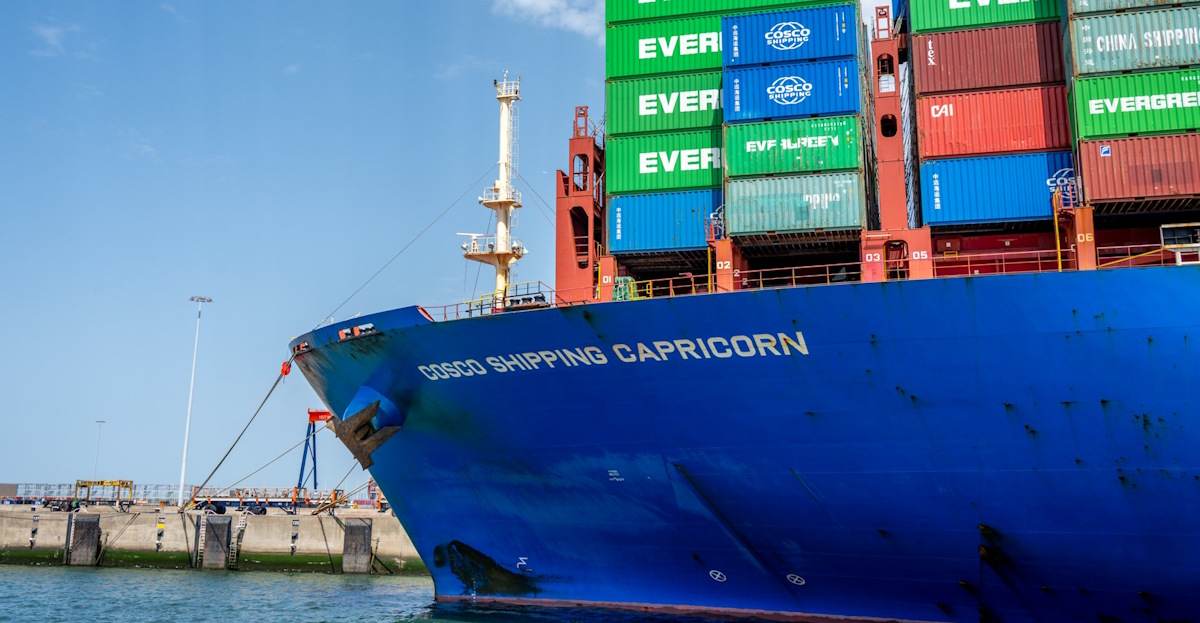
Karachi, Port Qasim and Gwadar sit outside the chokepoint, on the open Arabian Sea. When the Gulf became difficult, cargo came to them. Roughly 3,000 Iran-bound containers were diverted to Pakistani ports. Karachi cleared 8,860 transshipment containers in the first 24 days of March, more than it handled in all of 2025. Gwadar has moved about 200,000 metric tons of transit breakbulk cargo over the three months to early August, according to Yu Bo chairman of China Overseas Ports Holding Company, which operates the port.
That is the part of Pakistan’s case that no longer needs arguing. The ports worked when the Gulf did not, and shippers learned it under pressure.
Where the corridor still leaks
The same episode showed what has not been built yet.
Vessels waited for an average of 5.5 days at Karachi during the surge, against 1.5 days at Colombo and 24 hours at Chennai. Clearance took three to 6 days where the international benchmark is 48 hours, with demurrage between $85 and $290 per container per day. Gwadar’s approach channel is dredged to 11-12.5 meters against a depth of 14, so the largest container vessel cannot berth. A 2025 recommendation to cut dwell times by 70 per cent. As of May it had not been implemented.
The trade figures track the same gap. Pakistani exports to the 5 Central Asian republics in FY26 came to $190.5 million, down 4.1 per cent. Uzbekistan was the exception, up 18 per cent.
Part of the explanation lies in Afghanistan, and it is not primarily a Pakistani story. Kabul has been reducing its dependence on Pakistani routes by policy. Deputy Prime Minister Abdul Ghani Baradar instructed Afghan traders to end that reliance in November 2025, a pharmaceutical import ban followed in February, and Afghan trade with the Central Asian states climbed from about $1.48 billion in 2023 to $2.62 billion in 2025. Transit through Pakistani ports fell accordingly to 11, 592 containers worth $638 million in FY26.
The crossings themselves are still shut. Torkham has now been closed for close to a year, and on September 4, the Khyber Chamber of Commerce and Industry put the cost at $2.5 billion, including $1.64 billion in lost exports and PKR 7.7. billion in provincial cess revenue. Its president, Yousaf Afridi, asked the government to separate trade with neighboring countries from politics.
Islamabad has hedged against the shift rather than wait it out. The Transit of Goods Order 2026 created six designated corridors across Pakistani territory and tied them to the international TIR regime. The Gabd-Rimdan terminal on the Iranian border opened in April, and the first sealed consignment ran from Karachi to Tashkent. A second route goes from Sost through Xinjiang to Bishkek, which Pakistan and Uzbekistan formalized in July.
These are early. The two corridors together moved a little over 14,000 metric tons in their opening months, which proves the route works without making it an artery yet.
What the chairmanship year should buy
Pakistan spent the last phase getting political access. The next one is about output, and two commitments can do most of the work.
The first is a transit regime that traders can forecast in the form of notice periods, defined closure criteria and published rules that are not contingent on the temperature of a bilateral relationship. This is not an outside prescription. It is what Pakistan’s own chambers have been asking for and their reasoning behind it is commercial rather than political. A shipper in Almaty can price fuel, distance and handling. He cannot price uncertainty, so he routes around it.
The second is measurable performance. Dredge Gwadar to its design depth. Hold clearance to 48 hours. Publish monthly port data so the improvements can be checked by the people being asked to rely on it.
There is a wider debate for doing this, and it is the one Pakistan should be making at the SCO table. Five landlocked economies currently reach the sea through routes that run past a single contested waterway, across sanctioned territory, or through a neighbor whose policy can change without warning. That concentration is the region’s economic vulnerability, and this year demonstrated it. A functioning southern outset does not fix Central Asia’s politics. It does, however, reduce how much leverage any one strait or transit holds over five countries at once, and that is a real contribution to regional stability, of the unglamorous kind that shows up in freight rates rather than communiques.
Central Asia does not need convincing that Pakistan is close to the sea. It can read a map. What it is watching for is whether the berth is free, the customs hall moves and the gate stays open. Pakistan spent a decade making the political case and made it well enough to end up in the chair. Whether this year goes on dredging depth, clearance hours and published data is what decides if any of it moves freight.