

by Remi POTIER
A freight train leaving Xi’an for Duisburg, Germany, typically changes mobile networks several times before it reaches the Rhine. Each border brings a new operator, a new regulator and a new definition of what “good coverage” means. Gauge changes, customs checks and locomotive swaps at each frontier are documented in detail. The digital link that tracks the cargo, monitors the wagons and keeps the crew connected is mostly taken on faith.
That gap matters more every year. China-Europe freight trains made 20,022 trips in 2025, roughly 12 times the 2016 level. In 2024, the EU and its partners committed 10 billion euros to sustainable transport links in Central Asia, centered on the Trans-Caspian corridor. And the European Commission estimates that 584 billion euros must go into Europe’s electricity grids this decade, as distribution networks become digital, monitored in real time and remotely controllable.
As a recent Global Connectivities analysis of China and Europe’s energy opportunity noted, the value of shared clean-energy assets depends on the systems around them, including operational data and remote access. Those systems increasingly run over mobile networks. Yet there is still no common way to verify whether those networks perform as promised, especially where corridors cross borders.
Coverage maps are not performance
Europe learned this the hard way. The European Commission’s 2016 5G Action Plan called for uninterrupted 5G coverage along main transport paths by 2025. In 2022, the European Court of Auditors warned of a high risk that a majority of member states would miss that goal.
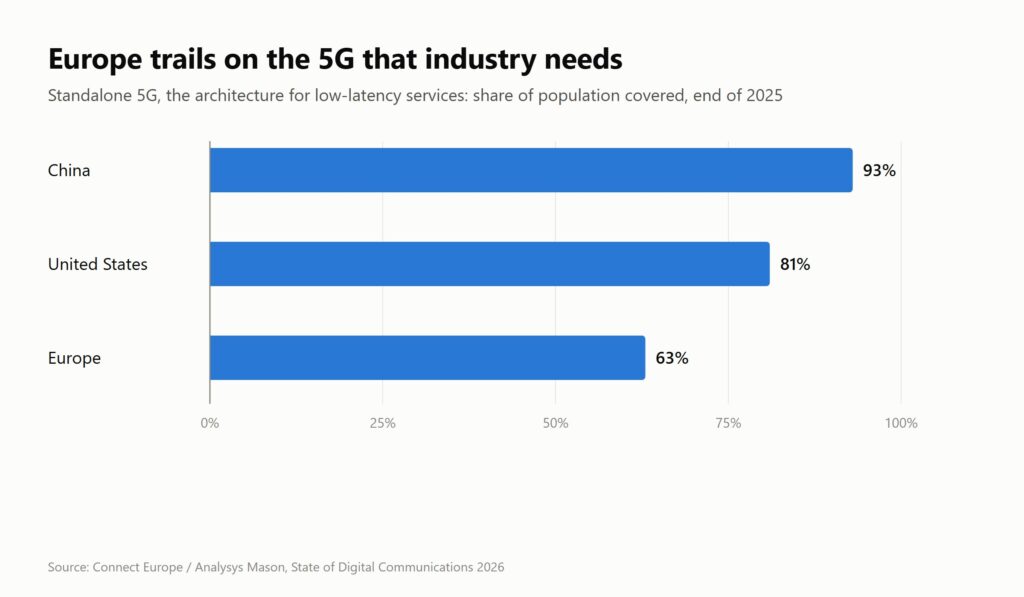
On paper, the picture now looks better. The Commission’s 2026 5G Observatory report puts basic 5G coverage at 96.8% of EU households. But coverage in the 3.4-3.8 GHz band, 5G’s main capacity band, reaches only 74.8% of households, and most networks still run on 4G cores. On standalone 5G, the architecture needed for low-latency industrial services, an industry study for Connect Europe puts population coverage at 63% in Europe, against 93% in China.
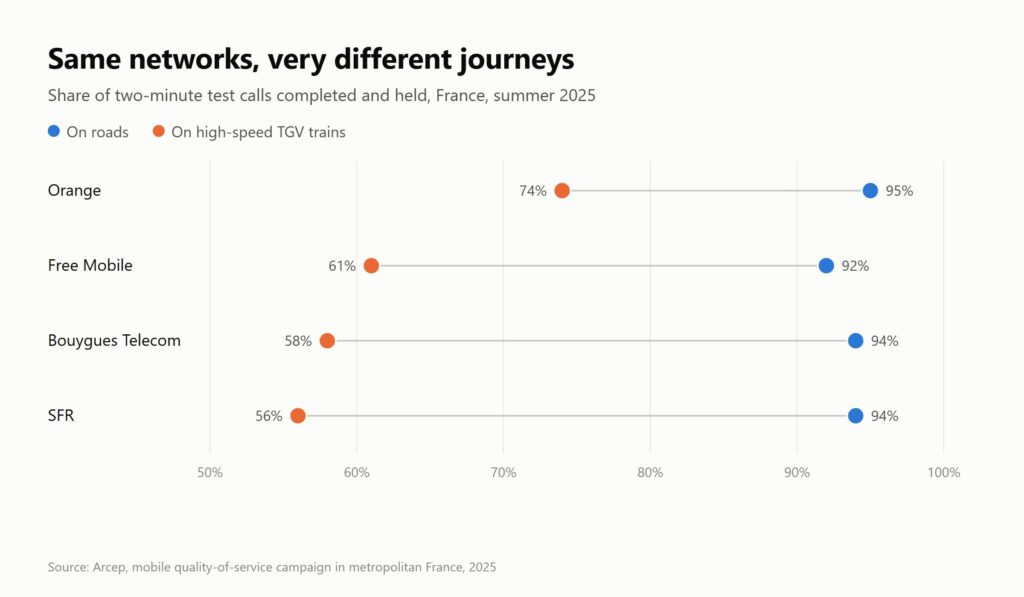
Household coverage says little about a motorway at a border crossing or a rail line at 300 kilometers per hour. France’s telecom regulator, Arcep, whose annual field campaign now exceeds 1 million measurements, illustrates the gap. In its 2025 results, every operator completed and held at least 92% of two-minute test calls on roads. On high-speed TGV trains, the best result was 74%, and the other operators ranged from 56% to 61%. Same networks, very different outcomes, depending on where and how quality is measured.
China has taken a different route, and in one respect a better one. In December 2023, its Ministry of Industry and Information Technology and other government bodies launched a “signal upgrade” campaign with targets set by corridor rather than by household: continuous mobile coverage along 30,000 kilometers of railways and 500,000 kilometers of highways by the end of 2025, plus minimum download and upload speeds. That is the right unit of measurement for connectivity corridors. Yet, as Light Reading observed, there is little public evidence of how operators are measured against those goals. Europe counts households, China counts kilometers, and neither publishes route-by-route results that the other could compare.
The border is the weakest link
Borders add a problem of their own. A phone or a connected truck tends to cling to its home network until the signal collapses, then searches for a new one. That hand-off between operators can interrupt a video call, a remote-monitoring session or a vehicle’s data link.
The EU-funded 5GCroCo project, which ran trials on a corridor linking France, Germany and Luxembourg, showed that the interruption can be cut to about 120 milliseconds with coordinated network configuration. That result came from a controlled trial. Whether everyday commercial networks at the border come close is something few authorities systematically check.
The tools to check exist. The International Telecommunication Union defines end-user quality parameters for mobile services in Recommendation E.804. The European Telecommunications Standards Institute has published best practices for network benchmarking and scoring. But national regulators apply them selectively. As early as 2017, BEREC, the body of European telecom regulators, acknowledged that national authorities measure coverage in different ways, which makes their results hard to compare.
There is an irony here. 5G itself is a single global standard, developed within 3GPP by European, Chinese and other companies working together. The network is built on one rulebook. Its performance is judged on dozens.
Why energy and logistics should care
For a logistics operator, a weak spot near a border means lost tracking data. For an energy company, the stakes are higher. Battery storage sites, wind farms and substations are increasingly monitored and controlled remotely.
Germany shows what happens when utilities cannot count on the networks around them. In March 2021, the federal grid regulator awarded the 450 MHz frequency band to 450connect, an alliance of energy companies, to build what the regulator’s president called a “blackout-proof” radio network for the energy transition. Rather than rely only on public mobile networks, the sector chose to build and finance its own. That may be the right call for the most critical functions, but parallel networks are expensive, and few countries along a China-Europe corridor can afford one for every sector. When a European utility relies on a Chinese-built storage system, or a Chinese investor operates assets inside the EU grid, both sides need evidence that the connectivity meets contractual and safety requirements.
Standardized benchmarking does not settle questions of cybersecurity or supply-chain risk. Those need their own rules. What it offers is something both sides can accept: neutral, repeatable data. When a contract specifies latency, availability or handover success, an agreed measurement method turns a promise into something that can be audited.
What a common yardstick would look like
A practical framework for corridor benchmarking would rest on five principles.
- Measure the corridor, not the census. Test along the actual routes, including border crossings, tunnels, rail lines and logistics hubs, at real travel speeds.
- Measure services, not just signal. Signal strength shows where a network exists. Latency, data throughput, call retention and handover success between operators show whether it works for the people and machines using it.
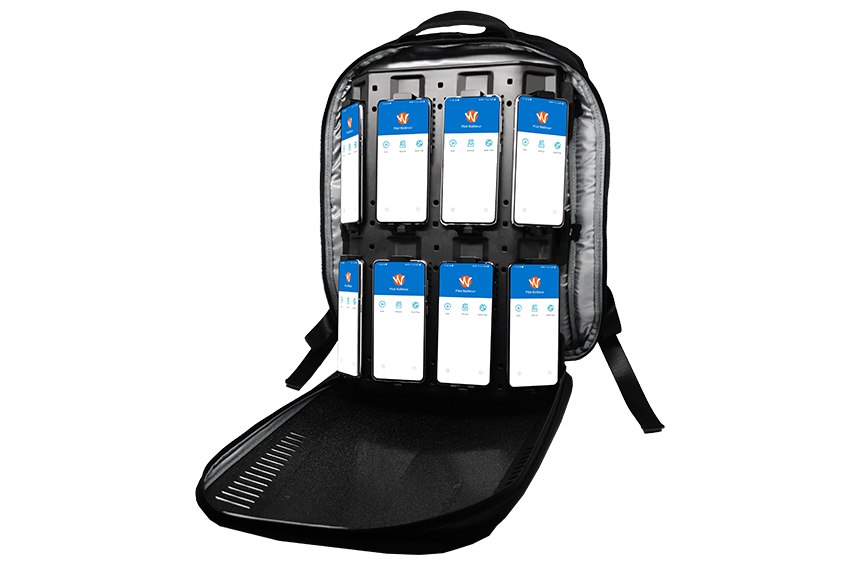
- Compare operators side by side. Results are only fair when every network is tested on the same route, at the same time, with the same devices. Commercial network benchmarking tools from test-equipment makers in Europe and China, including Dingli, a company the author works with as a consultant, already run this kind of simultaneous multi-operator drive test.
- Publish the method. Weighting and scoring rules should follow published ETSI and ITU references, so that results from Lyon, Ljubljana or Almaty mean the same thing.
- Make it joint and repeatable. Neighboring regulators can run cross-border campaigns together and publish open data, as Arcep already does nationally. Networks change constantly, so a one-time snapshot is not enough.
Where policy can start
The building blocks are already in place. The EU’s Connecting Europe Facility selected six cross-border 5G corridor projects, with 53 million euros in EU funding, under its fourth call. Making independent before-and-after benchmarking, using a common method, a condition of funding would show taxpayers what they bought.
Roaming policy points the same way. Since Jan. 1, 2026, Ukraine and Moldova have been part of the EU’s “roam like at home” area, and travelers are entitled to the same quality and speed as at home where the visited network allows it. That promise can only be verified if quality is measured consistently on both sides of the border.
Beyond Europe, the coordination platform created for the Trans-Caspian corridor and the long-running EU-China energy dialogue could add digital performance indicators to the metrics they already track for freight times and investment.
Corridors are judged by their weakest link. For decades, that link was a border post, a gauge change or a missing interconnector. Increasingly, it is a few kilometers of poor mobile coverage that no one has measured. A shared method for measuring 5G quality would not attract headlines, but it would give investors, operators and governments the same facts to work from. In cross-border cooperation, that is often where trust begins.