by Sebastien GOULARD
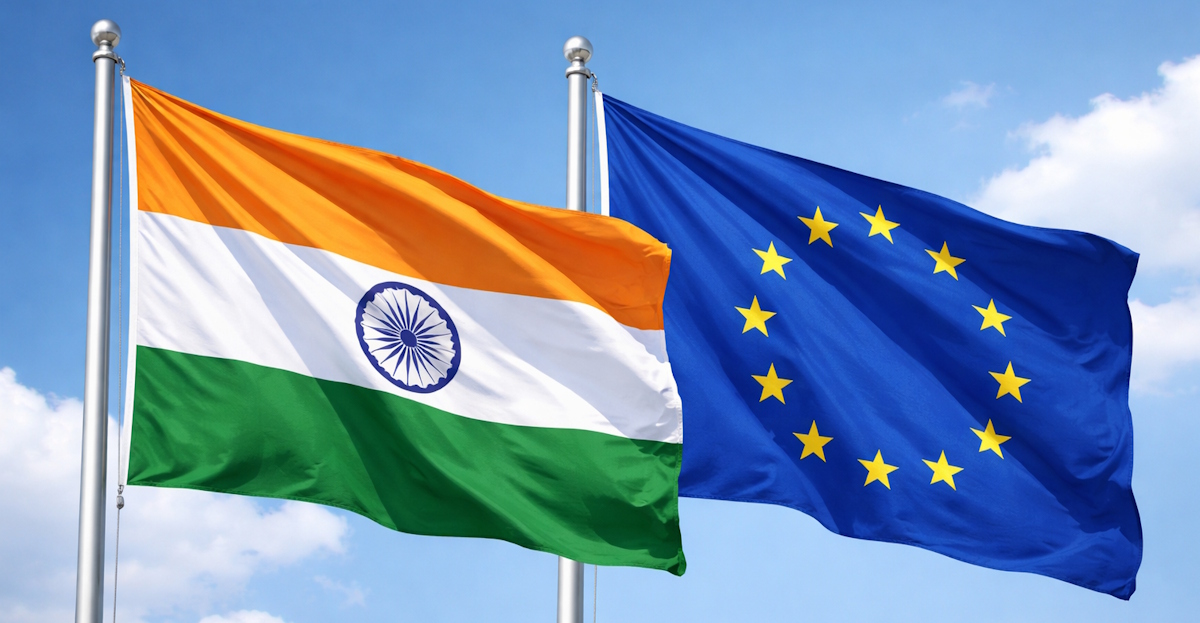
On 27 January 2026, on the occasion of the visit to New Delhi by the President of the European Commission, Ursula von der Leyen, and the President of the European Council, Antonio Costa, in the presence of Prime Minister Narendra Modi, a trade agreement was signed between the European Union and India. This agreement was described by Ursula von der Leyen as “the agreement of all agreements,” given the crucial commercial and political stakes it represents for both parties. It is a historic agreement that concludes nearly 20 years of negotiations (which began in 2007) and inaugurates a strengthened relationship between the two blocs, which together account for one quarter of global GDP.
More Integrated Economies
The primary objective of this agreement is to increase trade between India and the European Union. Today, trade in goods and services between the two blocs amounts to €180 billion, with the goal of doubling this figure by 2032. The potential for growth is significant, as these exchanges currently represent only 2.4% of Europe’s total trade with the rest of the world—far less than with the United States (17.3%) or China (14.6%).
This agreement will allow for a 90% reduction in customs duties on European products entering India, which should boost European exports, particularly in the aviation and agricultural sectors. High value-added agricultural products such as wine and olive oil could gain easier access to the Indian market. Tariffs on European wines would thus be reduced from 150% to 20% or 30%, depending on the category. Conversely, the European Union could continue to protect certain agricultural sectors—such as beef, poultry, or dairy products—against potential imports from India. As already observed with the agreement between the European Union and Mercosur, the issue of agricultural imports remains a major obstacle for several EU Member States; by excluding it, it becomes easier to secure acceptance of this agreement among European countries.
In the industrial sector, and the automotive industry in particular, this new trade agreement offers fresh opportunities for European manufacturers, who could expand their activities in India at a time when they are facing a certain slowdown in Europe. Currently, their market share is only 3% in a sector dominated by Indian or Japanese manufacturers. However, household car ownership remains very low (less than 10%), and the country’s economic growth could lead to a rise in demand.
This agreement should also allow European companies to gain access to India’s services market, notably in the transport sector, as well as in financial services. Several European banks are expected to open branches in India in the near future as a result of this agreement.
Particular attention is being paid to small and medium-sized enterprises. On both the Indian and European sides, one of the objectives of this agreement is to ensure that it does not benefit only large corporations, but also smaller firms seeking to explore new markets under optimal and reassuring conditions. India and the European Union should therefore strengthen their cooperation on intellectual property rights. In 2013, negotiations on this agreement had stalled over this issue. Today, both parties aim to reassure businesses so that they can fully take advantage of the agreement.
Another chapter of the agreement concerns sustainable development and societal issues. India and the European Union are expected to soon launch a joint cooperation platform on the environment and climate.
While the benefits that European companies may derive from this agreement appear clear, the interests it represents for India are also substantial. The agreement should enable deeper integration of the country into global supply chains and allow it to benefit from the European Union’s desire to diversify its partnerships in Asia.
The EU–India Mobility Partnership
Alongside this trade agreement, European and Indian leaders signed a mobility partnership aimed at facilitating the arrival of Indian students and workers in Europe.
Thanks to this agreement, the number of Indian students in Europe is expected to grow at a double-digit rate each year. Quotas on Indian students in European universities should be lifted. This decision comes at a time when the United States and the United Kingdom—the destinations that host the largest number of Indian students—are restricting Indian student admissions to their universities. It will also become easier for Indian students in Europe to obtain work permits after completing their studies. Indian professionals in certain key sectors may also benefit from easier access to work permits within the European Union.
Furthermore, it was announced that India could become fully associated with the European research programme “Horizon Europe,” which would enable both sides to strengthen their cooperation in the field of innovation.
Towards a More Comprehensive Partnership
The new trade agreement between India and the European Union reflects a rapprochement between the two powers, which is one of the consequences of the current geopolitical context. India and the European Union are seeking to diversify their partnerships on the global stage, particularly in relation to China and the United States. New Delhi and Beijing have developed new relations, notably through the resumption of direct flights between the two countries since October 2025. However, relations remain tense, and New Delhi aims to reduce its dependence on its Chinese neighbour. Similarly, Brussels is keen to rely on alternative commercial partners to China in Asia in order to reduce its trade deficit with Beijing.
The European Union and India are also closely monitoring decisions—sometimes abrupt—taken by the United States. The aggressive trade policy pursued by Washington through tariffs and protectionism (the United States has imposed 50% customs duties on Indian products since August 2025) is destabilising both Brussels and New Delhi. As a result, there has been an acceleration of the partnership between India and the European Union since the beginning of Donald Trump’s second term. However, for the European Council, India has already been at the heart of its Indo-Pacific strategy since 2021. This partnership is not limited to trade; it is also based on shared interests in defence and security, as illustrated by India’s announced acquisition of 114 Rafale fighter jets from France.
The new trade agreement between the European Union and India will therefore allow for a deepening of this partnership between the two blocs, which seek to assert themselves in the face of other global powers.