by Nimra KHALIL
In the rapidly changing scenario in the South Asian continent, the recent talks about the defense pact in Bangladesh and Pakistan provide a bright spot in their otherwise tense relationship. After the political changes in Dhaka in 2024, relations between the two countries started becoming warmer, ending in talks between the two high-ranking officials at the end of January 6, 2026. Bangladesh Air Force Chief Air Chief Marshal Hasan Mahmood Khan and Pakistan Air Chief Marshal Zaheer Ahmed Baber Sidhu discussed the possibility of importing the JF-17 Thunder fighter jet. This agreement falls under the Forces Goal 2030 plan to modernize the fleet economically. Pakistan’s expansion of its defense export industry benefits the country as well. Though the plans were criticized by neighboring country India in terms of their implications related to “security,” the plans and activities in reality correspond to being “defensive” rather than “offensive.”
Recent Discourses: Establishment of Operational Synergies
Talking regarding the meeting that took place on January 6, described in detail by ISPR of Pakistan, it was more than just an acquisition process. Discussions included technology transfer, combined training opportunities from basic to advanced levels, capacity building, and maintenance support for ageing Bangladeshi fighter jets. The commitment included immediate delivery of Super Mushshak training planes along with support services. The Bangladeshi team visited various places such as the National ISR and Integrated Air Operations Centre and PAF Cyber Command.
It is part of an engagement that continues with direct trade and flights (between Dhaka and Karachi from January 29, 2026), marking the end of the chill following the 1971 relations-strain. Bangladesh’s caretaker government, after the changes in 2024, is looking for “diversification in relation to their usual partners” and is identifying options that may include Chinese J-10s (with 20 ordered for $2.2billion) and Eurofighter Typhoons (memo of understanding is for 10-16). However, the cost of the JF-17 makes it an attractive fit for budget-conscious modernization.
JF-17 Thunder: A Cost-Effective Powerhouse
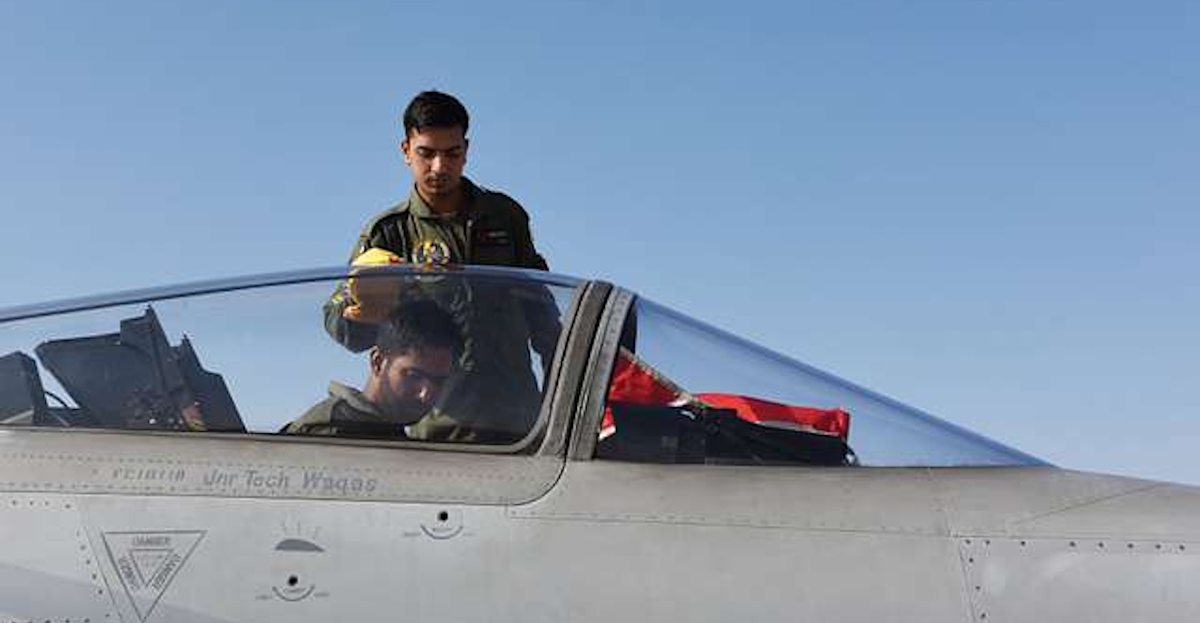
In the center of this dialogue are offerings like the “JF-17 Thunder Block III,” which is a 4.5-generation multi-role fighter jet co-developed by PAC (Pakistan Aeronautical Complex) in collaboration with Chengdu Aircraft Corporation of China. Its length is measured at 14.9 meters, featuring a wingspan of 9.4 meters, a maximum takeoff weight of 12,700 kg, and a Thrust/Weight Ratio of 1.07. Propelled by the Klimov RD-93MA turbofan (91.2 kN) engine, it operates in Mach 1.8 (1,910 km/h) speed, a ceiling of 55,500 ft, and a combat range of 1,350 km. Its AESA radar system, designated as the KLJ-7A, tracks target up to 170 km, in addition to avionics such as helmet-mounted displays, infrared search track, and electronic warfare
The aircraft is designed for carrying a maximum of 3,300kg of ordnance on seven hard points, ranging from PL-12 beyond the line of sight missiles, anti-ship CM-400s, precision-guided bombs, as well as a 23mm GSh-23-2 cannon. The JF-17 has seen action in a four-day conflict involving Pakistan’s May 2025 skirmishes with India, which were triggered by an April 22 false flag terrorist attack in Kashmir.
Pakistan’s Rising Defense Export Profile
Pakistan reaps enormous benefits through such agreements and establishes its crucial role in the international defense sector. Today, the JF-17 has won overseas sales contracts in Myanmar (8-16 aircraft), Nigeria (3), Azerbaijan (40 planes for $4.6 billion, an additional $4.6 billion after the initial $1.6 billion agreement), and Iraq (latest subscriber). Other countries under consideration include Libya ($4 billion for 16 planes along with other infrastructure), Sudan ($1.5 billion including drones and air defense systems), and Saudi Arabia ($2-4 billion loan swap for JF-17 sales). These sales, based upon the jet’s affordability, reliability, and achievements in the 2025 clashes, reflect the country’s increasing reliance upon homegrown technologies despite its limited $11 billion military expenditure (including pensions) for the 2025-26 periods, up by a record 20% after the conflicts.
Compared to the F-16/Gripen alternatives, the JF-17 provides similar capabilities but costs half as much with flexible payment and training models. The increased exports not only benefit the Pakistani economy but also promote South-South cooperation, which avoids dependence on the super powers.
Bangladesh’s Forces Goal 2030: Pragmatic Modernization
Bangladesh’s pursuit of the JF-17 fits its Forces Goal 2030, a plan to build a technologically advanced force amidst resource constraints. Having allocated $3.34 billion for defense in 2025-26, 1.9% of its GDP, with a slight increase but offset by inflation, Dhaka aims to phase out aging aircraft while pursuing supplier diversification. This includes 20 jets of the J-10CE from China at $2.2 billion for 4.5-generation capabilities, and also Eurofighter Typhoons-10-16 aircraft for $1.8-2.0 billion-for Western diversification. Interest in 48 JF-17 Block IIIs, initially a squadron of 16 aircraft for $720 million, points to a balanced approach to enhance airspace surveillance with radar integration without over-committing. This approach speaks to the vulnerabilities such as an average age of 19 years in most fleets and focuses on deterrence in the Bay of Bengal due to geopolitical changes.
Historical Thaw and Mutual Benefits
Post-1971 relations strained, but 2024 changes in Bangladesh opened doors for reconciliation. Resumed trade, military exchanges, and direct flights mark progress. This isn’t aggression but pragmatism, Bangladesh explores J-10s alongside JF-17s, showing no pivot to a Pakistan-China axis” but sovereign choices. Pakistan’s combat experience, from 2025 clashes (ceasefire May 10 via U.S. mediation), offers valuable training, promoting mutual growth and reducing superpower dependencies.
India’s Reaction: Vigilance or Overreaction?
“Closely monitoring” these discussions for security concerns, as stated by MEA spokesperson Randhir Jaiswal on January 9, appears to be an exaggeration on India’s part. In light of concerns for security of minority communities and geo-political changes, New Delhi has also cited narrower tensions such as Teesta water disputes, renewal of Ganges Treaty (set to expire in 2026), or border tensions. However, BSF-BGB face-offs regarding fence building, or 2024 floods caused by Indian discharge from Dumbur Dam, raise tensions. However, Bangladesh’s modernization is merely for defensive purposes, not an offensive stance. Budgets for 2025-26, at $81 billion for India, compare enormously with those of Pakistan’s at $11 billion or Bangladesh’s at 3.34 billion. There simply isn’t an imbalance here.
This has been simplified by the critics in India as the hostile turning point in the relationship. Strains since 2024, including the failure in water-sharing agreements and the issue of migration, compelled the Bangladesh government to turn to diversification. However, international diplomacy, particularly prior to the election in Bangladesh on February 12,
Regional Implications: Toward Multipolar Peace
Thus, mutual cooperation enhances peace through equalizing factors. The training and transfer of technology by Pakistan increase trust and mitigate terrorism and instability. According to Al Jazeera, the 2025 skirmishes between the nations only raised the attractiveness of the JF-17 without leading to escalation. Because of the dominance of India, being close to it guarantees peace and is an advantage for everyone. The Bangladesh and Pakistan initiative is the beginning of the realization of a multipolar South Asia wherein constructive relationships can overcome historical divisions. A self-reliant neighborhood is an advantage for a constructive and developing countries and promotes regional stability.