by Farwa IMTIAZ
At the intersection point of South Asia, Central Asia, China and the Arabian Sea, Pakistan lies in a geographic location that with its potential as a trade and transit hub just continues to be explored. As the regional processes are unfolding and the demand to have more diversified trade and energy corridors is increasing, Pakistan is transforming its image to become not a passive periphery of great power rivalry but an active node in connecting Eurasia. This is the change in geopolitics to geo-economics, which forms the foundation of modern Pakistani strategy, to use geography, infrastructure and diplomacy to attach Central Asia, China, the Middle East and other global markets.
Policy Vision: Pakistan’s Connectivity and Integration Goals
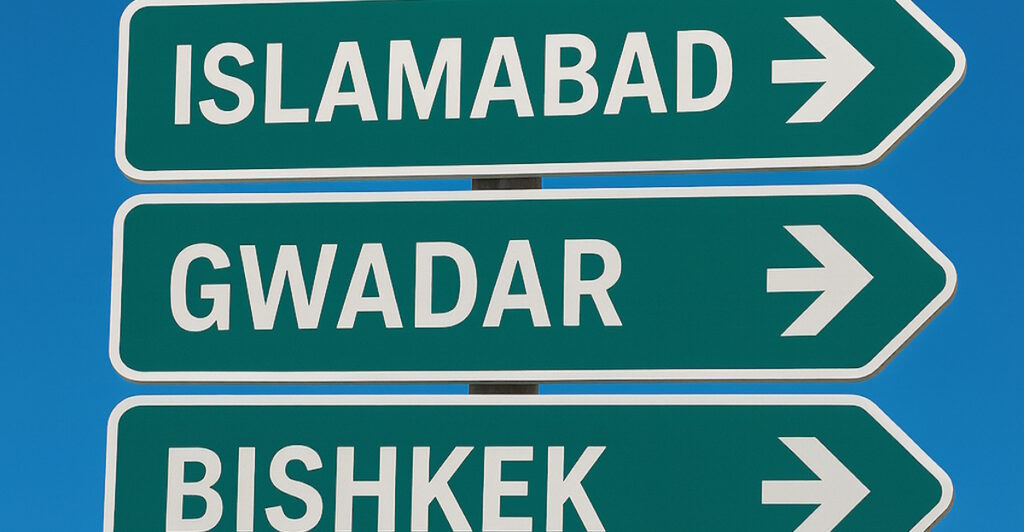
In December 2025, at the first Tianshan forum in Urumqi (Xinjiang), Pakistan Planning Minister Ahsan Iqbal unveiled an ambitious vision of turning Pakistan into the most efficient, dependable and cost-effective connectivity hub under linking Central Asia, China, South Asia, and the Middle East. In this vision, a 4-pillar integration framework was unveiled at Islamabad, comprising of a joint task force on economic connectivity and trade facilitation, co-development of regional special economic zones (R-SEZs), a Eurasian Energy Transition Partnership, and a Digital Silk Road and Future Skills Alliance (AI, fintech, cybersecurity and digital cooperation). Minister Iqbal emphasized that as part of China-Pakistan Economic Corridor (CPEC), Pakistan has already added about 8,000 Megawatts of capacity to its national grid, built more than 1,000km of modern motorways and operationalized Gwadar Port, which forms the base infrastructure of industrial zones, digital corridors and energy trade collaboration. With such an agenda, Pakistan hopes to become a transit state to a transit hub, which provides the shortest, fastest and cost-effective access to Arabian Sea. Pakistan has estimated, that the Gwadar route alone would save up to 70 percent of transit time in goods shipped by Xinjiang and Central Asia.
Bilateral Implementation: Kyrgyz Visit and Trade Initiatives
The high-level visit by the President of the Kyrgyz Republic to Islamabad in December 2025, the first Kyrgyz presidential visit to Pakistan in two decades, adds concrete weight to Pakistan’s connectivity vision. In the course of the visit, the two parties settled on the idea of speeding up the completion of a long pending trade agreement on transit, with express hope being that the bilateral business would increase by 6 to US 100million. At the current moment, the scale of trade between the two states is still low as the fiscal year report reveals that bilateral trade declined by approximately US11.2million to approximately US5.18million.
Trade is not the only central focus, energy and connectivity are also present as both Pakistan and Kyrgyzstan renewed their intentions to fully and successfully execute the CASA-1000, a regional electricity transmission initiative aimed at transferring excess hydropower produced in Kyrgyzstan and Tajikistan into Pakistan. The visit also included a business forum aimed at mobilizing private‑sector engagement, underlining that infrastructure and connectivity alone are insufficient, trade and investment involvement will be essential to unlock the full potential of these corridors.
Infrastructure & Energy: Ports, Corridors, and Power Projects
The Gwadar Port, which currently lies at the center of an expanded logistics strategy in the region (both by sea and land), is the core of geo-economic drive in Pakistan. The government seeks to include a new international airport, increase the capacity of the port, establish bonded warehouses, cold stores and install smart port technologies as part of the Maritime Affairs Action Plan (2025-2029) of Islamabad.
These projects are meant to make Gwadar a modern trans-shipment center, which will provide goods of Central Asia and China direct access to the Arabian Sea and therefore global shipping routes, without going through the longer, multi border routes. In the meantime, energy infrastructure such as CASA 1000 will connect Pakistan to hydropower excess in Central Asia, and will provide a way to deal with energy shortages in Pakistan, as well as provide yet another point of regional interdependence.
The combination of these factors (port, transport corridors, energy grid connections) creates a multi modal network, sea, land, electricity, which places Pakistan at the crossroads of both Eurasian logistics and energy flows.
Trade Potential: Growth Targets and Regional Impact
To reach the target of $100 million, it would be necessary to increase the level of trade by almost twenty times, which explains the pressing need to open new routes, streamline transit logistics, and bring participation of business world on board. The suggested transit trade agreement in combination with better connectivity via Gwadar and energy link projects provide a structural framework, through which such growth can be made possible.
The ripple effect may be felt more widely, though as landlocked Central Asian states, resource rich, infrastructure poor countries, Gwadar and overland corridors over Pakistan may have a very fundamental impact on their export routes, costs and air travel times, and place them in global supply chains. In the case of most of these economies, Gwadar is the closest, quickest and most economical access to the sea as suggested by Pakistan.
Regional and Multilateral Strategy: SCO, ECO, BRI
The connectivity drive of Pakistan does not happen in a vacuum. The nation plans to use several regional and multilateral structures such as the Shanghai Cooperation Organization (SCO), Economic Cooperation Organization (ECO) and the greater Belt and Road Initiative (BRI) to incorporate its corridors within a larger Eurasian network.
In its own definition, CPEC, CAREC (Central Asia Regional Economic Cooperation) and BRI are self-reinforcing highways of opportunity, which allow a pan Eurasian economic belt across the Arabian Sea to western China and Central Asia.
People and Private Sector: Education, Mobility, and Trade
In addition to infrastructure and diplomacy, Pakistan realizes that sustainable regional integration should include people and private enterprise. The Pakistani and Kyrgyz officials highlighted the need to increase collaboration in the areas of education, labor movement, and business connections during the Kyrgyz visit such as working on helping Pakistani students and employees work in Kyrgyzstan and the other way around.
The business forum that will take place in the frames of the visit will invite the firms of Pakistani and Kyrgyz private sector to negotiations regarding trade, transportation, and investment and will help shift the discourse on infrastructure development by states into economic exchange based on the market.
Conclusion
The meeting of diplomatic outreach (e.g., with the Kyrgyz Republic), visionary policy (through the Tianshan Forum), and profound infrastructure investment (Gwadar, CPEC, energy corridors) is preparing a new geo-economic role as one that is not a peripheral bystander (i.e., Pakistan), but rather, a central node, between Central Asia, China, South Asia, the Middle East, and the world economy.
The success is not that assured as to close the gap of the trade between the present bilateral trade volumes and the desired targets (the $100 million trade target with Kyrgyzstan) to achieve the desired outcomes, the logistical, regulatory, and institutional issues need to be resolved. However, when the various strands can be successfully brought together, i.e. maritime, rail/road, energy, diplomacy and involvement of the private sector then the geography of Pakistan can easily turn into a strategic asset.
In a world which is being characterized by regional connectivity and economic integration of Eurasia, Pakistan can become the strategic southern anchor of a new Eurasian economic belt, where ships, power, goods and people cross continents connected by steel, electricity and trade corridors.