by Sebastien GOULARD
The President of the French Republic, Emmanuel Macron, travelled to India for the fourth time for a three-day official visit from 17 to 19 February. During his stay, the French President and Prime Minister Narendra Modi worked to strengthen ties between India and France and announced the elevation of their relationship to the level of a “Special Comprehensive Strategic Partnership.”
After visiting Mumbai, President Macron took part in the AI Impact Summit in New Delhi, where he defended Europe’s position on artificial intelligence and called for stronger regulation of the sector.
This visit was primarily an opportunity to review progress on the “Horizon 2047” roadmap.
The Origins of the “Horizon 2047” Roadmap
President Macron’s visit to India is part of the “Horizon 2047” roadmap unveiled on 14 July 2023 during the exceptional visit of Indian Prime Minister Narendra Modi to Paris for the traditional Bastille Day military parade. The document marked the 25th anniversary of the strategic partnership that has linked the two countries since 1998 and outlined the ambitions set out by Paris and New Delhi for the centenary of the establishment of their bilateral relations.
The first objective of this roadmap concerns security and defence, including the development of joint projects and the sharing of expertise, particularly in the naval and aerospace sectors. This pillar also addresses the pursuit of stability in the Indo-Pacific region, notably through a model of triangular development cooperation bringing together India, France, and other like-minded states in the Indo-Pacific. The United Arab Emirates and Australia had been identified as potential actors in this trilateral cooperation. Furthermore, the two countries committed to working together on innovative projects aimed at strengthening their strategic autonomy and reducing their dependence on external powers.
The second pillar of the roadmap sets ambitions in the fields of environment and energy. Strongly committed to the objectives of the Paris Agreement on climate change, France and India jointly launched the International Solar Alliance to increase investment in solar energy worldwide. According to the roadmap, Paris and New Delhi are also expected to strengthen their cooperation in the field of nuclear energy, particularly with regard to the deployment of EPR reactors.
Finally, the last pillar concerns people-to-people exchanges between India and France, particularly academic exchanges and the increase in the number of Indian students in French universities.
Progress on Horizon 2047 Achieved During President Macron’s Visit
Emmanuel Macron’s visit to India can be described as a success. In terms of form, the French President, through his style and his morning jogging session in the streets of Mumbai, succeeded in attracting positive attention from the Indian media. Likewise, his participation in Raj Shamania’s podcast was widely noted.
Substantively, several major announcements were made. The first, and the one most widely covered by the media, concerns the acquisition of 145 Rafale aircraft by the Indian Army and Navy. These aircraft will be partly manufactured in India following technology transfers, as part of the partnership between Dassault Aviation and Tata Advanced Systems. This agreement reflects a high level of trust between the two capitals. Similarly, Airbus helicopters will be produced in Bangalore.
Regarding the “energy” pillar, President Macron and Prime Minister Modi reiterated their commitment to cooperate in the nuclear sector, as India seeks to significantly expand this source of energy in order to reduce its dependence on hydrocarbon imports.
An important element of the “people-to-people” pillar of the “Horizon 2047” roadmap concerns the mobility of Indian students to France. President Macron expressed his desire to welcome 30,000 Indian students, compared to 10,000 currently. This objective will be supported by the creation of dual-degree programmes between French and Indian universities. The aim is to build long-term scientific cooperation and thereby encourage Indian students to develop projects in France during and after their studies.
At the cultural level, new initiatives are expected in the coming years, notably through exhibitions in major museums such as the Musée Guimet in Paris, in order to enhance mutual understanding of French and Indian cultures in both countries.
Confirmation of the IMEC
The visit also confirmed the interest of France and India in working together on the construction of a strategic corridor linking Europe and South Asia through the IMEC project (India–Middle East–Europe Corridor), announced in 2023 but delayed due to tensions in the Middle East. An agreement was signed between the French port of Marseille-Fos and the Indian ports of Mumbai and Mundra.
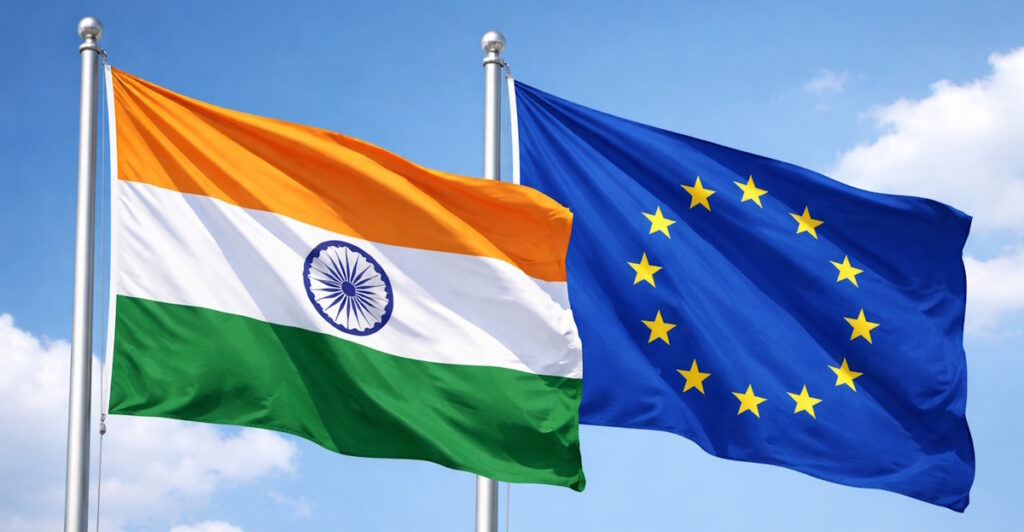
The Horizon 2047 roadmap is even gaining momentum and is expected to continue doing so. Beyond the agreements concluded between the two powers, there is a shared determination to diversify partnerships, particularly in a context of tensions with the United States and China. President Macron’s visit also fits within the framework of the trade agreement concluded between the European Union and India at the end of January. Increased exchanges between India and France (and its European neighbours) will enable both powers to gain greater room for manoeuvre vis-à-vis China and the United States and to negotiate future agreements with other countries more effectively.
This rapprochement is further reflected in the organisation of the Franco-Indian Year of Innovation, which will feature events in aerospace, health, sustainable development and culture.